
Table of Contents
Learning Objectives
- How Ghana’s climate and ethnic diversity shape its culinary traditions
- The foundational ingredients and food processing methods that underpin Ghanaian foods
- Master iconic Ghanaian recipes such as Jollof Rice and Fufu
- Confidently build a Ghanaian meal from pantry to plate using the book’s recipes
Course Materials
All Lessons will be hosted on Youtube. Subscribe below
Course Outline
Lesson 1: The Land, The People and Their Kitchen
Learning Objective
The foundations of Ghanaian cooking are based on the land and the people. Together, they shape what can grow, what is maintained and how food defines a culture. Ghanaian food is not a singular tradition, but a collection of diverse yet interconnected culinary traditions that spread across Ghana and beyond. This lesson offers deep dive into pantry staples and the factors that shape what Ghanaians cook with
Required Reading
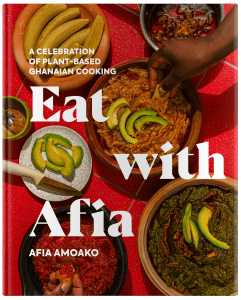
- Eat with Afia Cookbook What is Ghanaian Food pg 14 – 17
- Eat with Afia Cookbook Pantry pg 22- 45
Recipes mentioned
- Eat with Afia Cookbook Tatale pg 134 – 135
- Eat with Afia Cookbook Kelewele pg 136-137
- Eat with Afia Cookbook Ofam pg 144 – 145
- Atidua (Red Cowpeas Stew)
- Eat with Afia Cookbook Aboboi/Summa pg 189 – 191
- Eat with Afia Cookbook Light Soup pg 234-236
- Melon Seed soup
- Nigerian Pepper Soup
- Eat with Afia Cookbook Groundnut Paste pg 63
- Eat with Afia Cookbook Sobolo pg 116-117
- Eat with Afia Cookbook Dry Okro Soup pg 237-239
- Eat with Afia Cookbook Tofu Egg Stew pg 272 – 273
- Eat with Afia Cookbook Palm Nut Soup pg 222 – 224
- Eat with Afia Cookbook Groundnut Soup pg 225 – 227
- Eat with Afia Cookbook Hot Chocolate pg 124
- Eat with Afia Cookbook Corn Porridge pg 80
- Eat with Afia Cookbook Kebab Pepper pg 68
- Eat with Afia Cookbook Beans Stew pg 186 – 188
- Eat with Afia Cookbook Kelewele Spice Blend pg 70
- Eat with Afia Cookbook Emudro Shots pg 114-115
- Eat with Afia Cookbook Tea Bread pg 100 – 101
- Eat with Afia Cookbook Umami Spice pg 64-65
- Eat with Afia Cookbook All Purpose Spice pg 66-67
Additional Resources
- Climate, Vegetation and Soils in Ghana, pg 6-21
- An introduction to fonio
- The History of Millet in Ghana
- History of Africa – Season 3 — History of Ashanti Empire
- A Trip to the National Museum of Ghana
- Ghana 2021 Census
- A Detailed Introductory Video on Palm Oil
- Cultural Context of Palm Oil
- A Detailed Introductory Video on Shea Butter
- Shea butter tells the story of female agency
- Gastropod Podcast episode “The Most Interesting Oil in the World.”
- Intro to Moringa
- Grains of Paradise
- An Introduction to Fermented Locust Beans
Lesson 2: Building Blocks and Flavour Foundations
Learning Objective
This lesson focuses on building foundational flavour in Ghanaian cooking. It will cover spice blends and aromatic blends, which will be applied to make the most delicious tomato stew.
Required Reading
- Eat with Afia Cookbook Aromatics, Spices and Flavour Enhacers pg 38 – 46
- Eat with Afia Cookbook Spice Blends pg 65 – 68
- Eat with Afia Cookbook Frozen Soup Base Cubes pg 72 – 73
- Eat with Afia Cookbook Tomato Stew pg 263 – 265
Additional Resources
Lesson 3: Ghanaian Food Science - Fermentation
Learning Objective
Fermentation is an important food processing technique in various Ghanaian culinary traditions. Grains and spices are fermented to add diverse flavour and extend shelf life. In this lesson, we will go over the major ways grains and starches are fermented in Ghana; the science behind fermentation practice and go through a recipe that exemplifies fermentation in Ghana. Fermentation will feature in other recipes highlighted in this course; therefore; having a foundational understanding of fermentation is imperative.
Required Reading
- Eat with Afia Cookbook Fermentation pg 50 – 57
- Eat with Afia Cookbook Amorkple pg 295 – 297
Additional Resources
- The Science of Sourdough Starters
- Applications of Biotechnology to Fermented Foods: Report of an Ad Hoc Panel of the Board on Science and Technology for International Development.
- Alkaline Fermented West African Spices
Lesson 4: The Grain Older than the Sahara Dessert
Learning Objectives
There is a grain older than the Sahara dessert, where it’s kernels tell the story of migration and ingenuity. This lesson is all about millet; the traditions, history and recipes that have been shaped over centuries. We will explore millet through three major mediums — raw, fermented, and milled — highlighting its versatility and cultural significance. Millet will feature prominently across our course so a dedicated lesson is a must
Required Reading
- Eat with Afia Cookbook Sustainability Coming Full Circle pg 25
- Eat with Afia Cookbook Millets and Sorghum pg 26
- Eat with Afia Cookbook Drinks Introduction pg 108-110
- Eat with Afia Cookbook Zomkom pg 118 -119
- Eat with Afia Cookbook Millet Masa pg 96-99
- Eat with Afia Cookbook Konkori pg 106 – 107
Additional Resources
- Pearl Millet Uncovers West African History (Covers the history of Pearl Millet)
- Fonio – The Seed of the Universe (Covers the history of Fonio)
- Varieties of Millet in Northern Ghana
- What is early millet
- Consumption patterns of Early Millet in Northern Ghana
- Landrace Diversity and Heritage of Fonio
- Impact of Traditional Food Processing Techniques on Mineral Bioaccessibility in Ghanaian Fermented Millet-Based Koko and Zoomkoom
Lesson 5: Rice as a Foundation in Ghanaian Cooking
Learning Objective
Rice is a bedrock of Ghanaian cooking, and like millet, has a rich history in Ghana and across West Africa. In this lesson, we will explore the history and domestication of rice, the cultural systems built around rice, connections to the American south and the folklore behind jollof rice and its spread across the region.
Required Reading
- Eat with Afia Cookbook Rice pg 25 – 26
- Eat with Afia Cookbook Jollof Rice and the Never-Ending War pg 205
- Eat with Afia Cookbook Kolgo (Dawadawa) Jollof with Shea Butter pg 210-212
- Eat with Afia Cookbook Omotuo pg 280-281
Additional Resources
- The African Rice you have never heard about
- Carney, Judith A. 1998. “The Role of African Rice and Slaves in the History of Rice Cultivation in the Americas.” Human Ecology : An Interdisciplinary Journal 26 (4): 525–45. https://doi.org/10.1023/A:1018716524160.
- Carney, Judith Ann. 2001. Black Rice: The African Origins of Rice Cultivation in the Americas. Cambridge, Mass. London: Harvard University Press.
- Fields-Black, Edda. 2014. Deep Roots: Rice Farmers in West Africa and the African Diaspora. Indiana, Illinois Indian University Press.
- Fields-Black Edda, Bray Franscesa, Coclanis Peter A. 2017 Rice: Global Networks and New Histories. New York, NY : Cambridge University Press
- Jollof Rice History: How a Dish Took Over West Africa
Lesson 6: The Possibilities are Endless with Beans
Learning Objective
Beans is one of the most important and versatile ingredient in the Ghanaian kitchen. This lesson will dive into the beans we use in Ghanaian cooking with recipes that demonstrate the versatility of its use. If you are looking to incorporate more plant based protein that is also high in fibre, this is the lesson for you.
Required Reading
- Eat with Afia Cookbook Legumes pg 28
- Eat with Afia Cookbook Tom Brown Porridge pg 85 – 87
- Eat with Afia Cookbook Legumes pg 168 – 169
- Eat with Afia Cookbook Kose pg 179 – 181
- Eat with Afia Cookbook Tubaani pg 182 – 183
Lesson 7: Greens as the nutrition powerhouse of Ghanaian Food
Learning Objective
Greens feature prominently in Ghanaian culinary traditions. This lesson will introduce you to the diversity of greens we consume in Ghana with two recipe4s, one from northern Ghana, the other from Southern Ghana that highlight their importance in our cooking. You will also learn how to prepare the sides that accompany these recipes.
Required Reading
- Eat with Afia Cookbook Greens pg 37-38
- Eat with Afia Cookbook Peanut Amaranth Soup pg 85 – 87
- Eat with Afia Cookbook Kontomire Stew pg 168 – 169
- Eat with Afia Cookbook Boiling Root Vegetables and Plantains pg 317-319
Recipes Mentioned
- Eat with Afia Cookbook Omotuo pg 280 – 281
- Eat with Afia Cookbook Millet Sargbo pg 288 – 293
Lesson 8: Soups are the Bedrock of our Culinary Tradition
Learning Objective
Soups are the bedorck of Ghanaian cooking — recipes that have been built and curated over decades highlighting our indigenous food practices but as well as ingredients adopted. This lesson will walk you through three cornerstone Ghanaian soups that highlight our unique ingredients and culinary practices. Soup recipe also feature in Lesson 7 as well as Lesson 10.
Required Reading
- Eat with Afia Cookbook Groundnut Soup pg 222 – 224
- Eat with Afia Cookbook Dried Okro Soup pg 237 – 239
- Eat with Afia Cookbook Palm Nut Soup pg 225 – 227
- Eat with Afia Cookbook Soup and Edible Spoon Pairing pg 316
Recipes Mentioned
- Eat with Afia Cookbook Amorkple pg 294 – 297
- Eat with Afia Cookbook Millet Sargbo pg 225 – 227
- Eat with Afia Cookbook Tuo Zaafi pg 284 – 287
- Eat with Afia Cookbook Omotuo pg 280 – 281
Lesson 9: Not just Fufu - Edible Spoons
- Learning Objective
One of the most recognizable features of culinary traditions across the African continent is the ball of starchy ingredients used to accompany soups and stews. Ghana is no exception to this rule and we boast a diversity of staple balls to accompany various sauces and soups. This lesson provides an in-depth introduction to these significant recipes — demystifying cooking approaches, highlighting their diversity and providing step by step instructions on how to succeed making them. We will also cover the tools needed to execute these recipes well. The goal is to walk away from this lesson recognizing that not every starchy ball is fufu and they all represent diverse culinary traditions across the country.
Required Reading
- Eat with Afia Cookbook Not Just Fufu: Edible Spoons pg 274 – 278
- Eat with Afia Cookbook Tools and Tips pg 278 – 279
- Eat with Afia Cookbook Gari Fufuo pg 282 – 283
- Eat with Afia Cookbook Millet Sargbo pg 288 – 293
- Eat with Afia Cookbook Soup and Edible Spoon Pairing pg 316
Recipes Mentioned
- Eat with Afia Cookbook Omotuo pg 280 – 281
Additional Resources
Lesson 10: Fufu and Light Soup - A Deep Dive
Learning Objective
Continuing on from Lesson 9, this last lesson is all about fufu — specifically Ghanaian style fufu. In this lesson, we will break down southern Ghana fufu (the culture, the ingredients, the process) and walk you through two preparations of fufu on the stove top. We will pair this fufu with light soup, but a rendition of this recipe that pays homage to a historic preparation of the soup, one that uses an ingredient quickly fading from people’s kitchens.
Required Reading
- Eat with Afia Cookbook What is Fufuo pg 308 – 309
- Eat with Afia Cookbook Flour Based Fufu pg 310 – 313
- Eat with Afia Cookbook Fresh Plantain and Cassava Fufu (Stove Method) pg 314 – 315
- Eat with Afia Cookbook Light Soup pg 234 – 236