
Palm oil is one of the most important vegetable oils in the world. Its use is pervasive and, in recent times, a problem of industrialized farming’s impact on delicate ecosystems. However, before palm oil became a global commodity, it was, and still is, the most important oil across many West and Central African cultures. Through its growth, production, and uses, it highlights how indigenous food practices are focused on sustainability and well-being. As red palm oil is essential in many of my recipes, I have created a dedicated post that provides an overview of traditional palm oil in African cuisines. This post will discuss how palm oil is traditionally produced, what makes African palm oil different from commercial palm oil, the history of palm oil, its health benefits, and its cultural significance.
What is palm oil?
Palm oil is produced from the fruit and kernel of the African Oil Palm. An indigenous tree to the forested regions of sub-Saharan Africa, the oil palm has been an important part of traditional African cooking, culture and medical practices. It is a valuable source of vegetable oil because it yields two distinct oils from the same fruit: palm fruit oil and palm kernel oil. Each oil has different chemical properties that allow it to be used for different products.
However, how these two oils are prepared and processed distinguishes commercial palm oil from traditional African production. Given the stark differences, I believe these are two separate products that should be understood completely differently. While most commercial palm oil is grown in Southeast Asia and South America, there is a threat of expanding plantation-style palm oil production on the African continent, since it is of indigenous origin. However, the fruits will be exported for processing into commercial products, not relying on indigenous African processing techniques.

Commercial Palm Oil
- Odourless and Flavourless
- Produced from trees bred to be dwarfed with high oil output
- Grown in palm oil plantations that destroy important rainforests (South-East Asia and South America)
- Used for commercial skincare, processed food, and machine lubricants
Traditional African Palm Oil
- Bright red oil (palm fruit) or light yellow (palm kernel oil) with strong flavour
- Produced from trees that are not farmed plantation style and grow wild in African agroforests.
- Production follows traditional oil extraction methods, typically small batch production rooted in culture.
- All by-products of the oil production have a use
- Used for traditional African dishes, cosmetics (African Black Soap) and medicines.
This post centres on indigenous African palm oil and will not go into depth about the process of making commercial palm oil.
What are the flavours of Traditional African Palm Oils
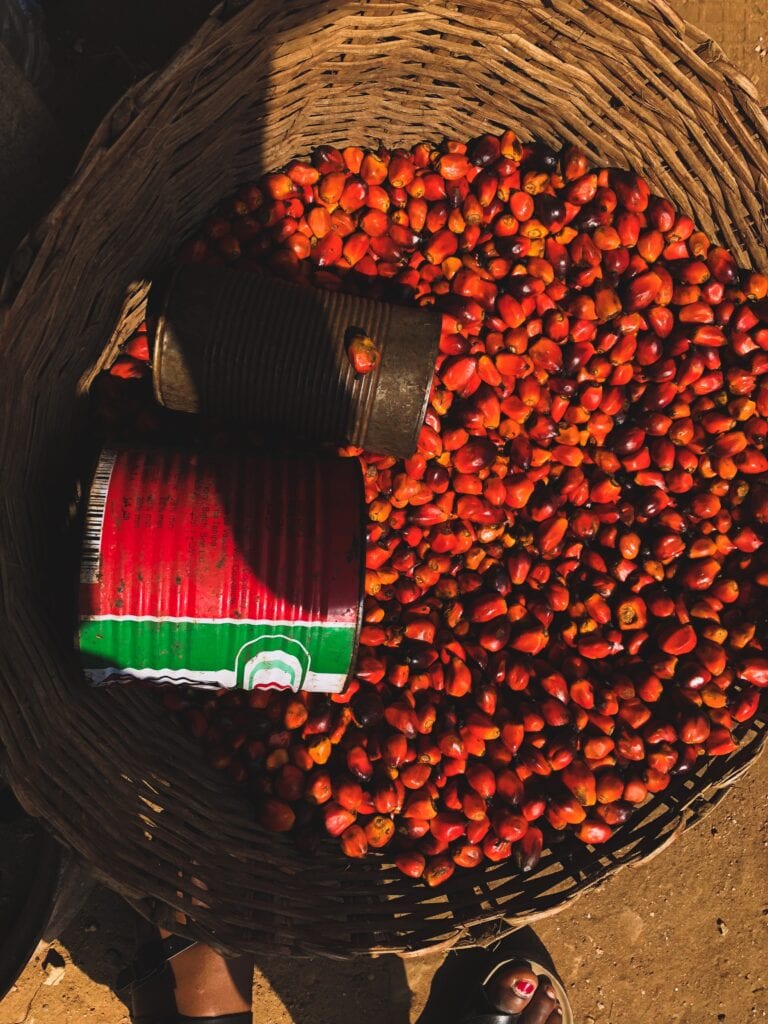
Both oils have different properties — in colour, flavour, uses, and taste. Red palm oil is bright red, like the fruit. The oil is savoury, buttery, and has a touch of bitterness, with notes of carrot, likely due to its beta-carotene content. Palm kernel oil is made from the nut within the palm fruit kernel and can range from light brown to pale white, depending on how well the oil is made. The oil has a slight coconut-caramel undertone and is a bit greasier. Like most tropical oils, palm oil is higher in saturated fat and can be solid at slightly cooler temperatures, more so palm kernel oil than red palm oil.


How is Palm Oil Used in Traditional African Cooking
Palm oil has too many uses for me to list. When crops have been part of your culture for centuries, people have definitely had plenty of time to explore all their uses.
Red palm oil is used in many stews and soups. It adds flavour and colour to our dishes. We fry foods in red palm oil or use it as a base for many stews and soups, much like how olive oil is used as a base for many Italian stews and soups.
Palm oil has many health benefits. People use red palm oil to treat mild food poisoning. Some add it to soaps and lotions. It is high in beta-carotene, a precursor to Vitamin A.

While red palm oil remains popular in West African cooking, palm kernel oil is slowly being replaced by regular vegetable oil in everyday cooking, which tends to have a higher smoke point and a neutral flavour. Yet to this day, my grandmother does not cook with any oil other than palm oil. For her, and many who came before her, palm kernel oil was the “neutral oil”. It was the everyday oil for cooking and frying. It was the lotion before lotions. Palm kernel oil is now widely used in indigenous soap-making. Along with ash from burned cacao pods, palm kernel oil is one of the key ingredients of African black soap. Its moisturizing properties and high vitamin E content make it a popular choice for soaps.
How are Traditional African Palm Oils Made
Oil production in West Africa is a lengthy process based on practices passed down through generations. Most often, they are done on a smaller scale with minimal industrialization. We look forward to the unique flavours of these unrefined oils and tailor our processing to these details, a major difference from commercialized palm oil production. Over-processing kills the flavours and nutrients we love. Water is crucial to oil production because of the different chemical properties of oil and water. Red palm oil and palm kernel oil are made in slightly different ways.
Below is the process for making red palm oil. Once this process is done. The leftover kernels can further be processed into palm kernel oil.

Palm fruit is washed and boiled until soft. The fruit is cooled and pounded. Water is mixed to separate the oil, which floats to the top. The stringy chaff of the palm fruit is saved to make fire. The kernels are separated for palm kernel oil. The red oil that settles on the top is boiled until all the water evaporates.
The palm kernel oil is slightly different. First, the kernels are cracked to remove the shell and roasted. The roasted nuts are ground into a paste, mixed with water and boiled. The oil separates to the top, and it is scooped out. The scooped oil is reboiled to evaporate extra liquid, leaving just the oil.
What is the History of Commercial Palm Oil
This problem has manifested itself as deforestation and threats to wildlife in Southeast Asia (Indonesia and Malaysia), a reality that is tied to colonialism, greed and the industrial revolution. At the turn of the 20th century, well into the height of the Industrial Revolution, palm oil was highly sought after for lubricating machinery, later for food production, and even for explosives. Soon, palm oil was at the centre of a profitable trade network between West Africa (mainly present-day Nigeria) and Europe. It was so lucrative that European trading companies were established to monopolize the trade of palm oil in West Africa. Trade was not easy, as many locals rightfully wanted to keep trade rights for themselves and were reluctant to sell the best-quality oil. As disputes were ongoing, the British and the Dutch took seedlings to Southeast Asia, where the colonial government had more control over land and labour. Southeast Asia was fertile with a similar climate to the forested regions of sub-Saharan Africa. After ongoing strife in Nigeria over palm oil, the companies that sought to establish a monopoly on palm oil were dissolved, laying the foundations for the British colony of Nigeria and Unilever (which still operates today).
Why is Palm Oil hated?
On the other side of the world, a tree that holds such significance and value to culture and food systems on the African continent was used to destroy the lives of millions just because of profit. Everyone that mattered lost — West Africans lost autonomy of rule to colonialism. Southeast Asian countries lost their land to commercialized palm oil. Plants and animals that call many forests in Southeast Asia home have been displaced by deforestation used to clear land for palm oil production. Oil palms in Southeast Asia have been bred to produce more oil, but it is less flavourful. Some of these cultivars have made their way to the African continent, and many are not fans.
How to source sustainable African Palm Oil?
I always purchase palm oil from the African store. These are the only establishments that sell palm oil made traditionally. It is very hard to find this in your local grocery store. I always check the label to identify the location of production, ensuring that it is a product of a West or Central African country. I buy oils sold in clear carafes because it is a way to judge their quality — namely, an oil that is bright red in colour.
This is why I treat commercialized palm oil differently from traditional African palm oil because they have different qualities and characteristics.
Resources to check out
“The Oil Palm: A Global History” by Jonathan Robins
“Planet Palm: How Palm Oil Ended Up in Everything,” by Jocelyn C. Zuckerman
I also relied on my travels across Ghana to learn about traditional palm oil production. You are welcome to learn all about it on this blog post or in the video below.
23 Responses
This is so helpful. Thank you.
Wow, simply put, I commend you on this article. I have lived in the west from 1978 to now, and have always wanted my torborgee oil. Liberian born American, there’s no other cuisine that can replace my torborgee oil, another form of deep red Palm oil. Growing up, we were told that “everything African was terrible and bad for human consumption”; that included palm and coconut oils. But today, coconut oil is excellent for human consumption to the fact that it is manufactured and sold in capsules for human consumption as vitamins. These are seen and sold also in large containers in large stores like Sam’s Clubs, Costco stores all around the U.S.. Why is coconut oil now good for human use all of the sudden? Palm oil, a red colored, vitamin enriched oil, has kept us, West Africans alive, given us rich dark skins etc. It comes in its natural forms and tastes when cooked in which ever way. Why would We, palm oil lovers want to change to anything else?
Westerners have down played everything African, and have forgotten that we are.just educated or even more, and now refuse to go back to that “slave mentality” thinking, that everything black, African is not good for humans. We’re too educated and knowledgeable about our lives and do not need your input. Eat yours and we’ll keep enjoying ours.
Red Palm oil is the richest oil on earth. The red color is beta carotene which converts to vitamin A. Red palm oil contains vitamins E and Coenzyme Q10. It has the highest amount of Tocotrienols found in any oil, this is a higher form of vitamin E.
Ndewo, daluu, for allowing others to see what the beautiful amazing tree is all about..and that red palm oil from west africa is the best..biko abeg cook me some that ofe egusi..happy new month and chineke gozi gi..
[…] picked up some red palm oil to cook with – it’s the cooking oil of choice for West African dishes, and adds a […]
i will never forget in a college course we watched a video about harrison ford going to indonesia to look at the destructive palm oil farms, and harrison was like “stopping this would be equal to taking 500k cars (or some other huge number) off the streets of L.A.” and none of us really challenged that!! but like… idk harrison, stick to getting those cars off the streets in your own city!!
Thank you so much! I had no idea.
tgulTbNmvc
I’m waiting https://is.gd/dBsd60
Hi,
I’ve bought my first ever bottle of red palm oil, because I’m very curious to try some west African dishes for the first time. I wish I saw your post sooner, because I spent half a day googling “palm oil in Ghana” to see if it’s environmentally ok to buy this oil :).
Anyway, my oil is of a brand “Afroase” and it’s made in Ghana. My question is – how is red palm oil supposed to smell/taste? Are you familiar with it being an acquired taste for new palates? Because I’m very curious to try some dishes with it, and I’m open to it tasting much better once it’s mixed with other foods and cooked with, as opposed to tasting the pure oil; that maybe it gives that “somethin’-somethin'” special, like it just wouldn’t be the same without it, even if it tastes unpleasant on its own. Is this how it is regarded? Because I really seem to dislike the taste on its own. It’s very difficult for me to explain how I perceive the taste. I don’t think it’s ‘rancid’ per se, or at least I *hope* it isn’t (and it’s 3 years before the ‘best before’ date). The smell is also quite pungent, with an almost ‘fishy’ quality to it? I googled *a lot* before ending up here, and got quite scared reading descriptions of ‘nutty, buttery, almost sweet taste reminiscent of carrots’, as this *profoundly* doesn’t describe my oil :).
I would appreciate a few words from a seasoned user like you. Thanks!
Aw, thanks so much. It’s such a disadvantage to be cooking something from another part of the world for the very first time and having no reference! I live in a place where I can’t visit a west African restaurant, or an African market or something like that.
Ok, so what I’m hearing from you is that palm oil might not taste nice at all on its own, but still taste good in a dish? I can work with that! 🙂 I was hoping you’d recognize the brand, but thanks for looking into it anyway.
On my quest for answers I did come across this forum: https://www.nairaland.com/32796/smelly-palm-oil where some Nigerian people suggest that there are actually two types of oil, one of them smelling very unpleasantly.
I was thinking of trying Ghanaian red red stew. How big of a difference would it be to use ordinary white beans (cannellini)? I know it’s culturally a ‘no-no’ :), but I really can’t get my hands on black eyed peas here. Would it be a good enough substitute?
thank you for this very informative article. in the west there is so much information about palm oil being bad, but I figured it was due to the way it was sourced and synthesized by the corporations. anyways thank you for the information, i am Italian and for the first time trying west African recipes.